
Himalayan balsam
What is Himalayan balsam?
Himalayan balsam (Impatiens glandulifera) is an invasive plant species that was introduced to the UK from the western Himalayas in 1839. Invasive species are non-native, and harm the environment they are introduced to by disrupting the balance of the ecosystem.
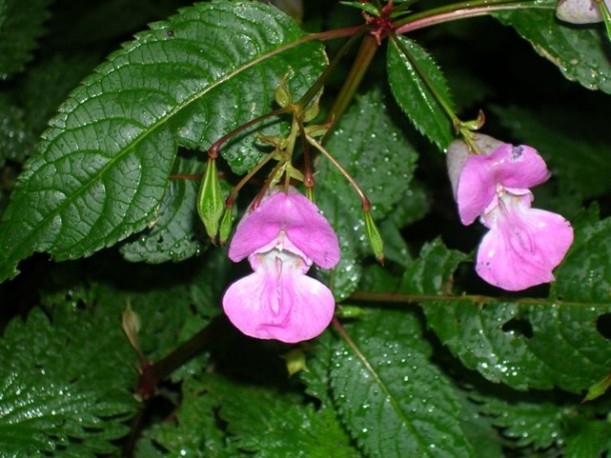
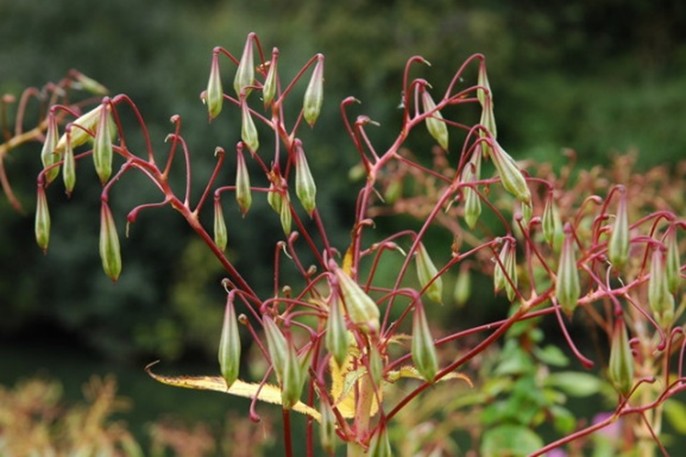
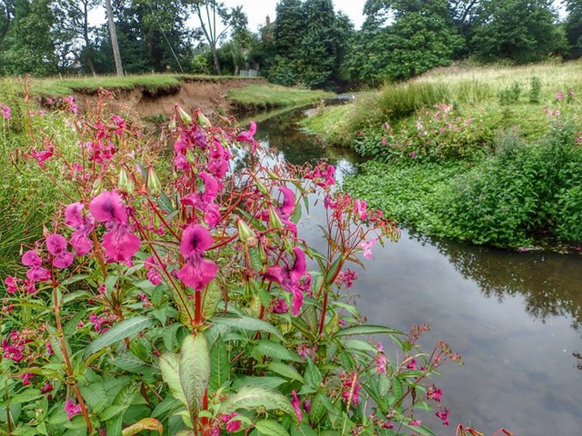
Himalayan balsam can typically be found clustered in areas with high levels of moisture, such as along rivers, in riparian habitats and damp woodlands. They have also been seen to invade transport networks such as train tracks and are able to quickly colonise disturbed areas like construction sites or wildfire sites. They are the tallest annual plant in Europe, growing up to 2.5 m in height, and are characterised by their green to red stem, large, bonnet-shaped pink flowers (approx. 4 cm) and serrated leaves (right). Ripe seedpods (left) are 2-3 cm long. Their stems are segmented with distinctive nodes, with leaves appearing in pairs opposite each other or whorls of 3 around these nodes.
Impacts of Himalayan balsam
Spread: Each Himalayan balsam plant can produce up to 2500 seeds, which can be ejected up to 7 m away from the parent plant and float downstream. This explosive dispersal style, seed buoyancy and high seed production lead to rapid growth rates, allowing H. balsam to spread swiftly through an area. They form dense, monospecific stands, where one single species dominates an area, outcompeting native species for resources such as nutrients, water and light.
Reduce pollination: Himalayan balsam diverts the attention of pollinators away from native plants; these species will see lower seed production, meaning they are less able to reproduce and repopulate the area, leading to a decline in species diversity.
Decomposition: Himalayan balsam is seen to have a detrimental effect on soil microbial populations (mycorrhizal fungi), impacting its ability to break down organic matter and replenish soil nutrients to aid the growth of new plants.
Increase flood risk: Himalayan balsam completes its life cycle in a single year, before dying back in late autumn-winter. Its shallow root system binds soil less effectively than native plants, and as the monoculture disappears, it leaves the riverbank exposed and the destabilised soil vulnerable to further erosion. Organic matter entering the water can create dams downstream, leading to increased flood risk due in combination to restriction of river flow and lack of vegetation cover to intercept rainfall.
What to do about Himalayan balsam?
Removal of Himalayan balsam is essential in ecosystem restoration for allowing native species to recover: a variety of management techniques have been introduced in the UK, including the release of two rust fungus strains (Puccinia komarovii var. glanduliferae) as a biological control to target the species, which successfully established itself in several susceptible colonies across the country. The most common method of Himalayan balsam management, however, is to remove plants manually by hand-pulling/cutting. To effectively hand-pull Himalayan balsam:
- The entire plant including the root system must be removed and trimmed/snapped below the lowest stem node to avoid reflowering. Grasp firmly and pull upwards to avoid breaking the stem too high.
- Care must be taken to avoid seed dispersal near water, and they should not be removed once seedpods are ripe. The ideal time to remove Himalayan balsam is every 3-6 weeks from May-July, particularly during June, and the area should be monitored for regrowth for at least 3 years.
- Ensure clear and safe access to stands; avoid trampling native plants or disturbing ground nesting birds to reach them.
- Pulled plant stems should be piled up and left to compost in one spot. Himalayan balsam cannot be disposed of in green waste bins or composted normally. A registered waste carrier must be used if removal of dead balsam from the site is necessary.
- PPE biosecurity protocol should be followed to prevent the spread of seeds between sites.
- Obtain landowner permission before picking balsam on private land.
- Train volunteers on species ID to prevent native plants from being removed mistakenly.
To completely eradicate it from the area, Himalayan balsam removal must cover the entire catchment to prevent recolonisation from upstream. It is also important to repeat removal efforts for at least three consecutive years as seeds are viable for 2 years
This method’s reliance on regular and repeated removal means that it is often highly reliant on organised volunteer groups and education and retaining public support is a key aspect of Himalayan balsam management. It is important to ensure communities are equipped with the skills and knowledge to identify Himalayan balsam, safely remove plants, and record locations.
Himalayan balsam can be recorded on the INNS (Invasive Non-Native Species) Mapper or using SEWBReC on-line recording system SEWBReCORD or LERC Wales App on your mobile device.
This post is also available in: