
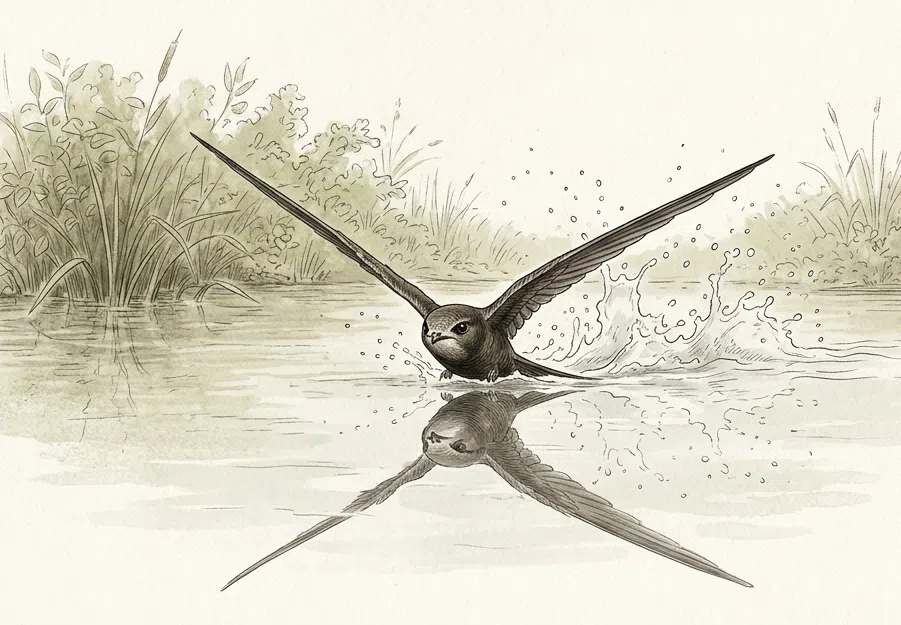
Illustration of Swift flying over river (Yogi Communications)
Look up: Swifts Project
The two-year Local Places for Nature conservation project ‘Look Up: Swifts’ began in 2025, when a swift tower (including a swift caller) was built in the Incredible Edible Garden in Usk County Hall . The project is being delivered by Monmouthshire County Council’s Green Infrastructure Team (with support from the MCC Arboricultural Team, local swift groups and town councils). It is funded by the Local Places for Nature funding from Welsh Government and is administered by Wales Council for Voluntary Action (WCVA).
We have also delivered swift walks and talks to raise awareness with the public about the serious decline in their population, and how the way we manage our buildings contributes to this. We have surveyed Monmouth for existing breeding sites and have added them to Swift Mapper.
In 2026, we are continuing the swift conservation work by collaborating with Swifts of Usk and Chepstow Swifts to carry out an audit of suitable sites in Monmouth, Chepstow, and Usk for the installation of swift nest boxes. We have already worked with Monmouth Comprehensive School sixth form and have installed 4 swift boxes with swift callers on their premises.
Since the project has commenced, a new local swift group in Abergavenny has been set up. We are supporting their initial swift project, in partnership with Abergavenny Community Centre.
We have commissioned felt swifts, house martins, sand martins and swallows to be created as education resources to be used alongside swift booksin the near future , in local community hubs and for other engagement ventures.
Click here to listen to a swift call.
About swifts
Common swift (Apus apus) populations have declined by 58% across the UK and 75% in Wales since 1995, and are now on the Red List of Birds of Conservation Concern.
Swifts & their nests are fully protected under the Wildlife & Countryside Act 1981. This makes it illegal to intentionally, or recklessly kill, injure, or take a swift, or to take, damage or destroy an active nest or its contents.
Monmouthshire County Council has declared a Nature & Climate Emergency, including the Nature Recovery Action Plan, to help reverse the decline in biodiversity, so we have a critical role in maintaining & enhancing biodiversity when carrying out our own operations.
Swifts nest almost exclusively in both old and modern buildings, making use of small holes to raise their young, such as on walls, under eaves, or under tiles. They pair for life and remain loyal to their nests, returning to the same nest site each year. However, with lots of old buildings being renovated to improve insulation, small holes being filled, buildings demolished, and scaffolding/netting being put up, it means our swifts are losing their traditional nesting sites.
Fun facts:
- An ‘acrobat of the sky’, swifts can reach speeds of up to 69 mph
- Their torpedo-shaped body makes them extremely aerodynamic
- With a wingspan of 45 cm on average, swifts have long, pointed wings in the shape of a boomerang or scythe
- Swifts only land to breed – they spend most of their life on the wing (in flight)
- They undergo migration from sub-Saharan Africa to Wales for their nesting season from the end of April – August
- They do ‘press-ups’ in their nests to build strength
- Despite their physical similarities, swifts are actually more closely related to hummingbirds than swallows or house martins
If you find a grounded swift, they need specialist care, do not try to throw or release the swift from a height, or attempt to feed the swift.
Wear protective gloves, eye protection & mask, Place the bird on a towel in a small cardboard box with holes for ventilation. Wash hands afterwards. Ideally, contact Swift & Swallow SOS on Facebook to find a local swift specialist, or take to your nearest vet.
Swift tower – Incredible Edible Garden, Usk (2025)
The Usk Incredible Edible Garden’s swift tower contains enough nest boxes to house 12 pairs of swifts. As well as supporting a species in decline, the swift tower is also a beacon of Monmouthshire’s commitment to biodiversity, education, and community wellbeing. As an environmental sculpture, it is an opportunity to inspire learning and connect people with nature. The swift tower was funded by the Gwent Green Grid Shared Prosperity Funding, for enhancing Green Spaces. As of the beginning of May 2026, the tower has been switched back on to attract this year’s juvenile swifts, with its swift calls being played from 6 am-9 am and 6 pm-9 pm every day.
Swift box installation locations


Swift box installation at Monmouth Comprehensive School
To aid this iconic species, our project will share key information with communities about swift conservation: the importance of existing small holes in buildings used by swifts, and the creation of artificial nesting sites such as swift boxes (with swift callers) or swift bricks, close by to existing breeding colonies.
We are in the process of finalising suitable sites around Chepstow, Monmouth and Usk to install more swift boxes based on where the existing colonies are, and which buildings are the most suitable – at least 5 boxes will be given to each town, with more to come further along in the project.
We have provided callers and timers to local town councils for their own boxes.
Currently installed at: Monmouth Comprehensive School, Wyesham Scouts
Install your own swift box!

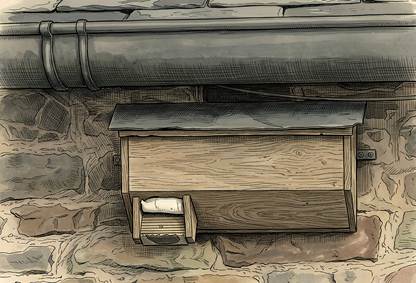
Illustrations of swift box (Yogi Communications)
To install a swift box, please go to our MCC GI team swift leaflet, to follow instructions on how to build swift boxes, and how to ensure conditions are optimal for swifts and their chicks.
Help count swifts:
Submit your own sightings of swifts to SwiftMapper or join a Swift Walk. Anyone can submit records, but they only want records of breeding swifts in natural nest sites or swift boxes, as well as screaming groups of swifts seen at roof height. Mapping breeding swifts helps us know where active nest sites need to be protected, and potential new nesting opportunities.
Resources
- Swift Mapper: Record swift nest sites & screaming swifts.
- Occupied Nest: where swifts are observed using a nest site cavity.
- Previously Occupied: where swifts were known to nest previously but no longer do so.
- Nest Box: nesting sites deliberately provided for swifts – nest boxes, nest bricks, etc. Whether occupied yet or not.
- Screaming Party: records of swifts flying at around roof height, often flying fast in groups, and often giving loud screaming calls. This behaviour indicates that swifts are breeding nearby.
This post is also available in: